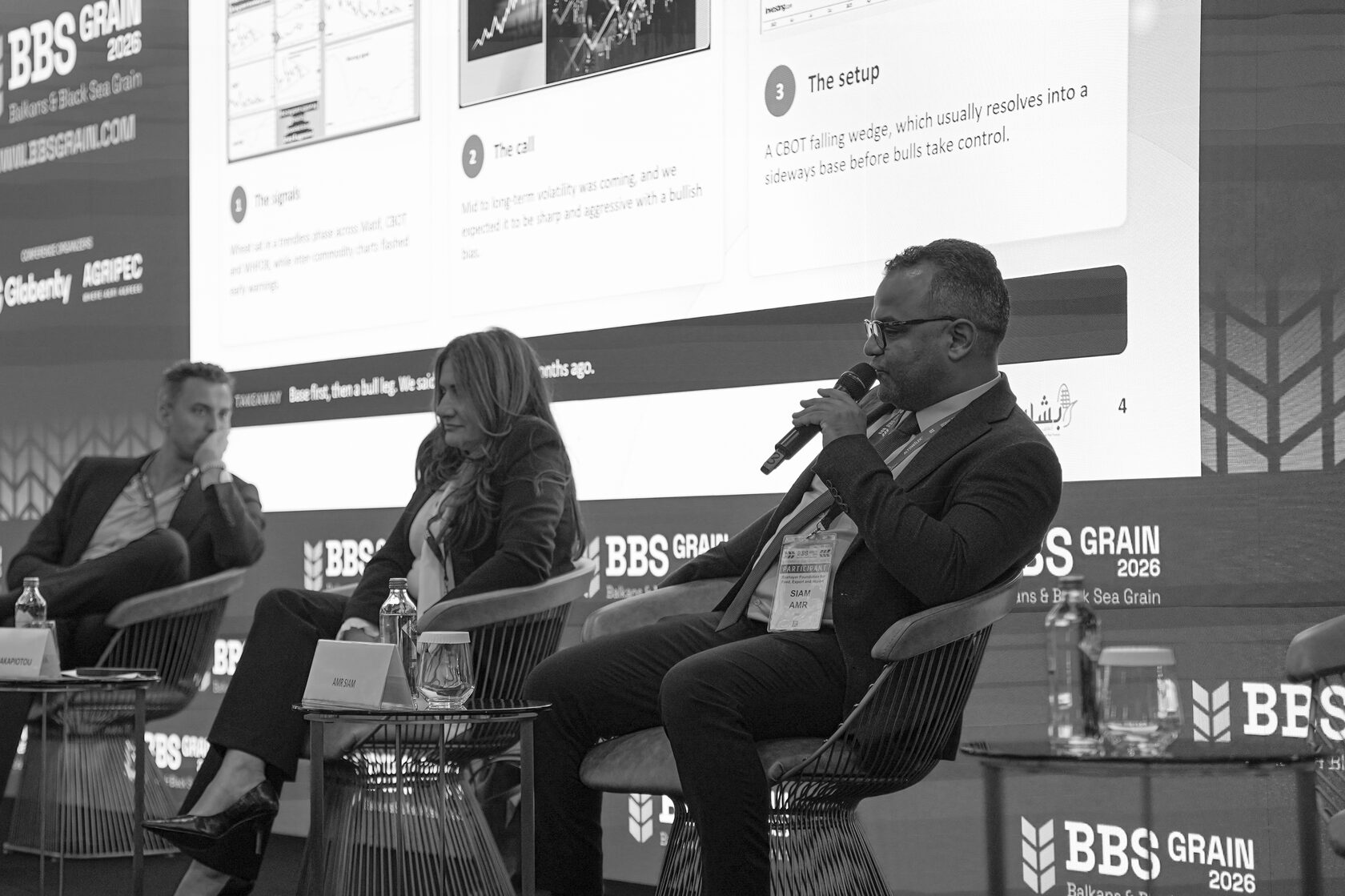
Istanbul, Türkiye — September 22, 2026 — The Balkans & Black Sea Grain 2026 (BBS Grain 2026) conference brought together grain traders, exporters and importers, logistics companies, flour milling businesses, commodity brokers and other industry professionals from more than 30 countries worldwide.
The conference provided an international platform for discussing the changing dynamics of grain and oilseed trade across the Black Sea and Balkans, bringing together different parts of the agricultural commodities supply chain — from producers, traders and exporters to importers, logistics and shipping professionals.
Against the backdrop of changing regional trade flows, evolving import demand and new challenges for logistics and shipping, BBS Grain 2026 focused on the factors shaping the future of agricultural commodity trade. Discussions covered export markets, production and supply conditions, oilseeds and vegetable oils, import demand in the Middle East and Africa, as well as logistics infrastructure, freight economics, vessel availability and risk management.
The programme also created opportunities to connect market perspectives with the physical side of grain trade, bringing commercial, logistics and shipping considerations into the same discussion.
Black Sea and Balkan Grain Trade Is Adapting to New Market Realities
One of the central themes of BBS Grain 2026 was the changing structure of grain trade across the Black Sea and Balkans.
The conference examined how export potential, production conditions, import demand and market diversification are shaping regional grain trade. At the same time, the competitiveness of an origin is influenced not only by the price of the commodity itself, but also by the ability to secure supply, arrange transportation and deliver grain reliably.
The discussions at the conference reflected these changes across both exporting and importing markets.
Serbia’s Export Potential Is See to Increase
Serbia is seeing a significant increase in its export potential for the 2026/27 season.
Wheat exports are projected to reach 2 million tonnes, while corn and barley are expected to reach 1.35 million and 190,000 tonnes, respectively.
Wheat exports are projected to reach 2 million tonnes, while corn and barley are expected to reach 1.35 million and 190,000 tonnes, respectively.

Türkiye’s Grain Market Is Becoming More Differentiated by Crop
Türkiye’s grain outlook shows increasingly different dynamics across the main crops.
Wheat production is projected to increase by around 30%, while barley production is expected to rise by around 20%. At the same time, corn production is expected to decline by around 10% and remain dependent on imports, with import quotas continuing to be part of the market outlook.
Wheat production is projected to increase by around 30%, while barley production is expected to rise by around 20%. At the same time, corn production is expected to decline by around 10% and remain dependent on imports, with import quotas continuing to be part of the market outlook.
Competitiveness Goes Beyond the FOB Price
The discussions on Black Sea origins also highlighted a broader approach to export competitiveness.
For Romania, competitiveness in the current market is not defined by the lowest FOB price, but by the ability to load, insure and deliver grain on schedule.
With capital becoming increasingly scarce, the competitive advantage is also shifting upstream — towards financing farmers and securing grain at the farm level.
Egypt’s Wheat Demand Remains Closely Linked to Black Sea Supplies
Import demand was another major focus of BBS Grain 2026, particularly in the Middle East and Africa.
The Black Sea accounted for 83.1% of Egypt’s January–August 2026 wheat import value. At the beginning of the new import season, Egypt imported 1.02 million tonnes in July–August, 49% less than during the same period of the previous season.
With around 11.5 million tonnes still to be covered this season, the pace at which Black Sea supply flows can be restored remains a key question for the Egyptian wheat market.
Sub-Saharan Africa Emerges as a Key Direction for Flour Exports
The development of new destination markets was also an important part of the discussion around Türkiye’s flour exports.
Sub-Saharan Africa offers the clearest near-term regional opportunity for Türkiye’s next phase of flour exports.
At the same time, Syria continues to support current export volumes, while selected African and Asian markets can help reduce market concentration. Competitive wheat access and higher-value products are important factors in determining how much further growth Türkiye can capture.

The Danube and the Wider Logistics Chain
As regional grain flows develop, logistics capacity is becoming an increasingly important part of the trade equation.
The Danube is becoming increasingly strategic for European grain and commodity flows, but its capacity cannot be viewed separately from the wider logistics corridor.
Navigation, ports, rail, storage, inspections and insurance all form part of the wider logistics chain.
As grain flows grow, reliability across the wider chain becomes increasingly important. Shippers will pay for reliable transit times, but not indefinitely for uncertainty and waiting.
Freight Rates Do Not Tell the Whole Shipping Story
The logistics discussion also focused on the economics of Black Sea grain shipping.
Higher freight rates do not necessarily translate into higher earnings or successfully shipped cargoes. At the same time, unprecedented EWRI premiums are weighing on vessel earnings.
Higher freight rates do not necessarily translate into higher earnings or successfully shipped cargoes. At the same time, unprecedented EWRI premiums are weighing on vessel earnings.
What Will Shape the Next Phase of Black Sea and Balkan Grain Trade?
The discussions at BBS Grain 2026 showed that changes in Black Sea and Balkan grain trade are increasingly interconnected with developments across the wider supply chain.
Export potential, import demand, production conditions and market diversification are closely linked with logistics capacity, shipping economics, risk management and the ability to deliver commodities reliably.
The conference also demonstrated the importance of bringing different parts of the supply chain into the same conversation — from grain traders and commodity companies to flour millers, logistics providers and shipping specialists — allowing market developments to be considered from both the commercial and physical perspectives.
Business Meetings and Networking
Particular attention was given to direct business communication and the development of professional connections.
The programme included meetings, introductions and negotiations during registration, coffee breaks and lunch, providing participants with opportunities to continue discussions beyond the conference sessions.
Grain Gala Dinner
Partners and Media Support
The programme included meetings, introductions and negotiations during registration, coffee breaks and lunch, providing participants with opportunities to continue discussions beyond the conference sessions.
Grain Gala Dinner
- The programme concluded with the Grain Gala Dinner, creating an informal setting for further communication and networking among participants.
Partners and Media Support
- Partner: S13 Commodities DMCC
- Info partners: GAFTA, Agricultural sector, Allfoodonline, PortNews, Argus, Miller Magazine
Looking Ahead: World Grain and Pulses Forum 2027
The global grain and pulses industry will meet again in Dubai on 15–17 March 2027.
Registration is now open.
👉 Learn more & register: https://globenty.com/graindubai
Registration is now open.
👉 Learn more & register: https://globenty.com/graindubai