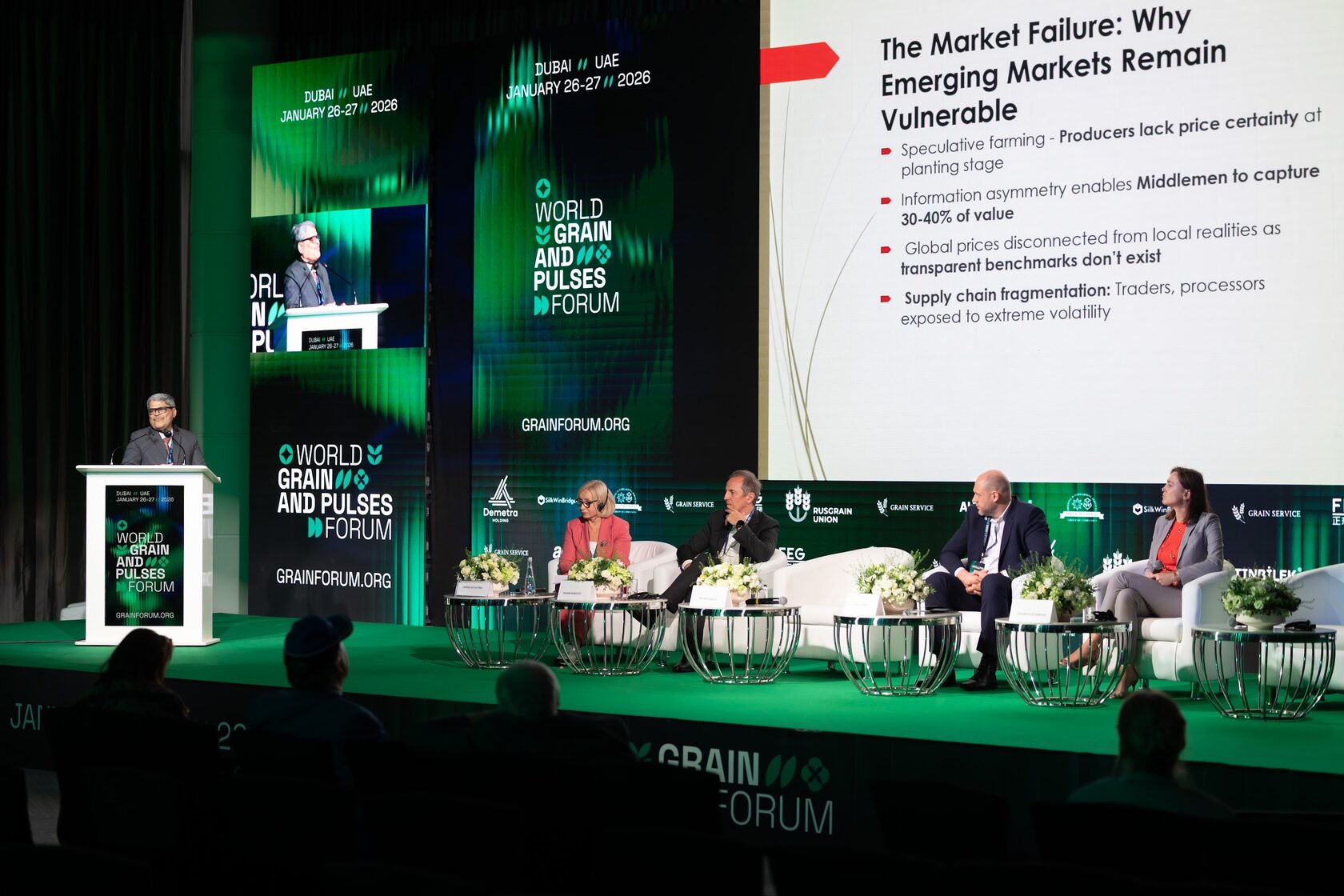
Global grain markets are entering a phase where volatility is no longer seasonal — it is structural.
At World Grain & Pulses Forum 2026, Dr. Arun Raste, Managing Director & CEO of NCDEX (National Commodity & Derivatives Exchange Limited, India), outlined why emerging grain markets must urgently develop exchange-based mechanisms to remain competitive and resilient in an era of climate shocks, geopolitical risk, and fragmented logistics.
His key message was clear: volatility is inevitable — institutional preparedness is not.
At World Grain & Pulses Forum 2026, Dr. Arun Raste, Managing Director & CEO of NCDEX (National Commodity & Derivatives Exchange Limited, India), outlined why emerging grain markets must urgently develop exchange-based mechanisms to remain competitive and resilient in an era of climate shocks, geopolitical risk, and fragmented logistics.
His key message was clear: volatility is inevitable — institutional preparedness is not.
The Structural Shift in Global Grain Markets
More than 850 million smallholder farmers in emerging economies produce nearly half of global agricultural output. Yet these markets often lack transparent price discovery mechanisms and modern risk management tools.
At the same time:
Traditional post-harvest pricing models are no longer sufficient. Modern markets require continuous pricing signals and proactive risk transfer mechanisms.
At the same time:
- Global grain trade exceeds $1.5 trillion annually
- Price volatility ranges between 40–60%
- Climate and geopolitical risks increasingly drive non-seasonal disruptions
Traditional post-harvest pricing models are no longer sufficient. Modern markets require continuous pricing signals and proactive risk transfer mechanisms.
The Core Market Failure
Emerging grain markets face several structural weaknesses:
1. Speculative production decisions
Farmers plant without reliable forward price signals, increasing income uncertainty.
2. Information asymmetry
Middlemen may capture 30–40% of value due to lack of transparent benchmarks.
3. Fragmented supply chains
Traders and processors remain exposed to extreme price swings.
4. Disconnection from global benchmarks
Local prices often fail to reflect international fundamentals due to missing institutional infrastructure.
These gaps limit the ability of emerging markets to become true price-setters, despite their growing share in global supply.
1. Speculative production decisions
Farmers plant without reliable forward price signals, increasing income uncertainty.
2. Information asymmetry
Middlemen may capture 30–40% of value due to lack of transparent benchmarks.
3. Fragmented supply chains
Traders and processors remain exposed to extreme price swings.
4. Disconnection from global benchmarks
Local prices often fail to reflect international fundamentals due to missing institutional infrastructure.
These gaps limit the ability of emerging markets to become true price-setters, despite their growing share in global supply.

Exchange-Traded Instruments as a Market Organizer
According to the presentation, exchange-traded instruments are not simply financial tools — they are structural stabilizers.
Their role includes:
A central counterparty structure eliminates settlement uncertainty and builds trust across borders — particularly critical in volatile regions.
Spot–futures integration further enhances liquidity and improves hedging efficiency for producers and traders alike.
Their role includes:
- Transparent global price discovery
- Efficient transfer and distribution of risk
- Counterparty risk mitigation through clearing mechanisms
- Standardization of contracts and quality specifications
A central counterparty structure eliminates settlement uncertainty and builds trust across borders — particularly critical in volatile regions.
Spot–futures integration further enhances liquidity and improves hedging efficiency for producers and traders alike.
GCC and Import-Dependent Regions: A Case in Point
Import-heavy regions such as the GCC illustrate the stakes clearly.
With up to 85% food import dependency, countries in this region are highly exposed to:
Without structured hedging tools and benchmark transparency, basis risk becomes increasingly unpredictable.
With up to 85% food import dependency, countries in this region are highly exposed to:
- Red Sea disruptions
- Volatile freight markets
- Supplier concentration risks
- Policy shifts in exporting countries
Without structured hedging tools and benchmark transparency, basis risk becomes increasingly unpredictable.
Institutions Matter More Than Products
One of the strongest insights from the presentation was that markets are stabilized not by products alone, but by institutions.
Key pillars include:
Stable, rule-based policy frameworks significantly reduce systemic volatility, while unpredictable policy interventions amplify global price swings.
Key pillars include:
- Deep liquidity pools
- Harmonized international standards
- Warehouse infrastructure and certification systems
- Technology-driven trading access
- Cross-border regulatory recognition
Stable, rule-based policy frameworks significantly reduce systemic volatility, while unpredictable policy interventions amplify global price swings.

Investment Opportunities in Market Infrastructure
As volatility rises, infrastructure becomes an asset class in itself.
Opportunities include:
Capital formation in rural areas improves when income predictability increases — encouraging long-term productivity investment.
Opportunities include:
- Regional clearing houses and settlement systems
- AI-powered crop forecasting and pricing intelligence
- Climate-controlled warehousing networks
- Cross-border liquidity pools
- Structured asset-backed lending models
Capital formation in rural areas improves when income predictability increases — encouraging long-term productivity investment.
The Strategic Takeaway for Global Grain Trade
The global grain market is no longer defined solely by production volumes.
It is increasingly shaped by:
Emerging markets may hold significant production power — but without organized exchange-based systems, they remain vulnerable to structural volatility.
The conclusion is pragmatic:
Volatility cannot be eliminated.
But markets can be structured to absorb it.
It is increasingly shaped by:
- Institutional maturity
- Risk-transfer mechanisms
- Infrastructure depth
- Regulatory harmonization
Emerging markets may hold significant production power — but without organized exchange-based systems, they remain vulnerable to structural volatility.
The conclusion is pragmatic:
Volatility cannot be eliminated.
But markets can be structured to absorb it.