
As part of its collaboration with leading international market experts, GLOBENTY is pleased to publish an exclusive market analysis based on the latest Market Impact Report by Caio Cugler, Principal Research Analyst at S&P Global Commodities at Sea.
The report examines how the emerging El Niño cycle could influence agricultural production, export flows and global grain trade across three of the world’s leading grain exporters — the United States, Argentina and Brazil. Rather than affecting agricultural production uniformly, the analysis suggests that El Niño is likely to reshape competitive dynamics across the global grain market as weather conditions evolve over the coming seasons.
The report examines how the emerging El Niño cycle could influence agricultural production, export flows and global grain trade across three of the world’s leading grain exporters — the United States, Argentina and Brazil. Rather than affecting agricultural production uniformly, the analysis suggests that El Niño is likely to reshape competitive dynamics across the global grain market as weather conditions evolve over the coming seasons.
El Niño Expected to Reshape Global Grain Trade
According to the latest S&P Global Commodities at Sea Market Impact Report, El Niño conditions have developed and are expected to strengthen significantly before gradually weakening in early 2027. Historically, the climate cycle has produced markedly different outcomes across major agricultural regions. Argentina has generally benefited from improved growing conditions, Brazil has experienced mixed regional effects, while impacts across the United States have typically varied by crop and location.
These regional differences have the potential to influence not only crop yields, but also export volumes, trade flows and commodity prices. Rather than creating a single global outcome, El Niño is expected to alter the competitive landscape among the world’s major grain exporters as production prospects evolve throughout the season.
These regional differences have the potential to influence not only crop yields, but also export volumes, trade flows and commodity prices. Rather than creating a single global outcome, El Niño is expected to alter the competitive landscape among the world’s major grain exporters as production prospects evolve throughout the season.
United States: Corn Faces the Greatest Pressure
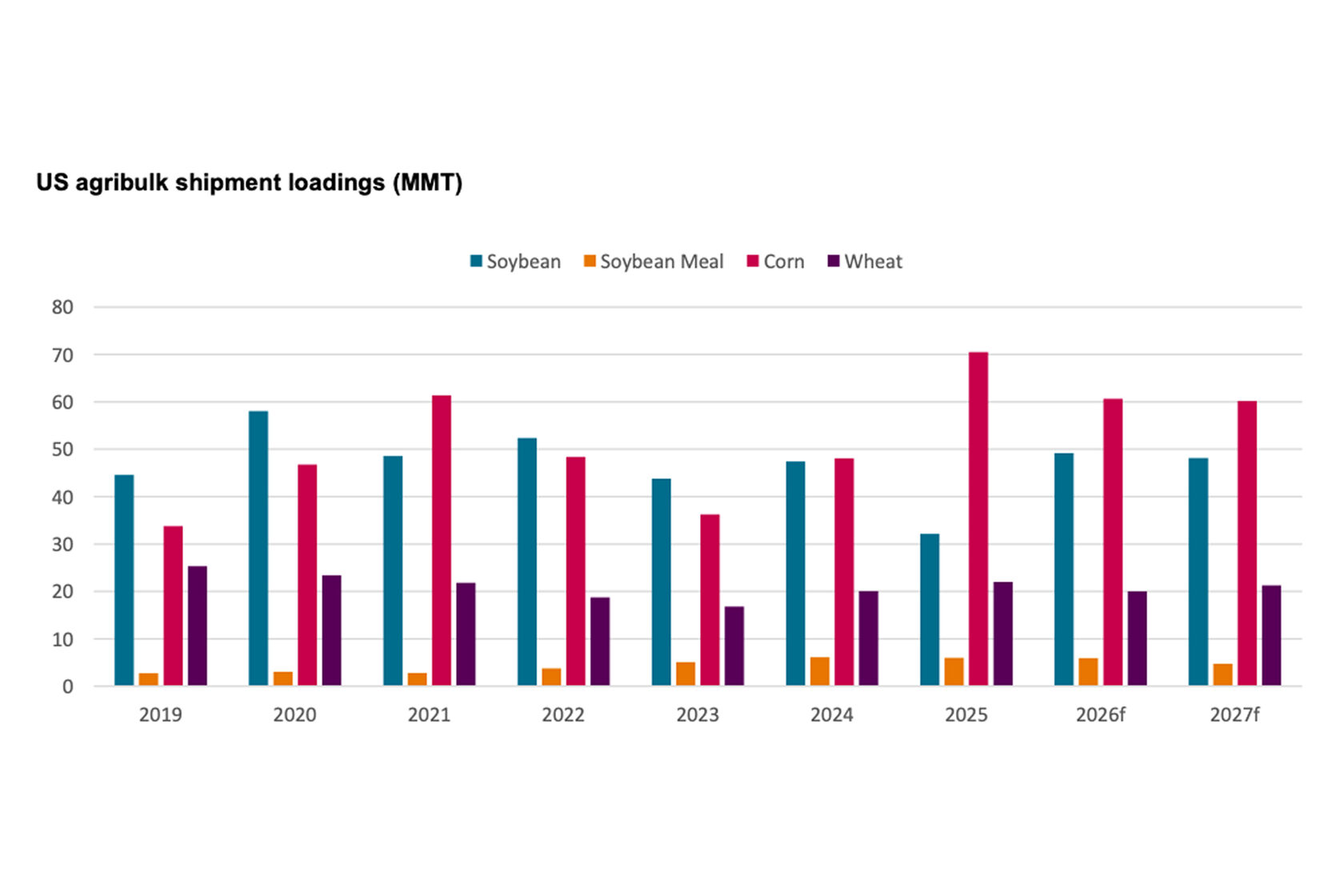
Among the world’s largest grain exporters, the United States is expected to experience the most uneven impact from El Niño. According to S&P Global Commodities at Sea, corn is likely to be the most affected commodity, with 2026 shipment loadings forecast at 60.7 MMT, representing a 14% decline compared with the previous year.
By contrast, soybeans are expected to experience a more limited direct impact from El Niño. Shipment loadings are projected to recover to 49.2 MMT, supported not only by favorable yield expectations but also by the anticipated recovery of Chinese trade with the United States following previous tariff disruptions. Wheat exports are expected to remain broadly stable, maintaining the elevated levels seen in 2025 with only limited fluctuations over the next two seasons.
Overall, the report highlights that El Niño is unlikely to affect all U.S. crops equally. While soybeans and wheat are expected to remain comparatively resilient, corn is projected to face the greatest pressure, illustrating how climate patterns may reshape the competitive position of individual commodities within the U.S. export portfolio.
By contrast, soybeans are expected to experience a more limited direct impact from El Niño. Shipment loadings are projected to recover to 49.2 MMT, supported not only by favorable yield expectations but also by the anticipated recovery of Chinese trade with the United States following previous tariff disruptions. Wheat exports are expected to remain broadly stable, maintaining the elevated levels seen in 2025 with only limited fluctuations over the next two seasons.
Overall, the report highlights that El Niño is unlikely to affect all U.S. crops equally. While soybeans and wheat are expected to remain comparatively resilient, corn is projected to face the greatest pressure, illustrating how climate patterns may reshape the competitive position of individual commodities within the U.S. export portfolio.
Argentina: One of the Largest Agricultural Beneficiaries of El Niño
Historically, Argentina has been one of the largest agricultural beneficiaries of El Niño events. Increased rainfall across the Pampas region typically improves soil moisture, supporting stronger yields for key crops, particularly corn and soybeans. As a result, El Niño has often strengthened Argentina’s export potential during previous climate cycles.
According to the latest S&P Global Commodities at Sea projections, Argentina’s corn shipment forecast has been revised to 42.2 MMT for 2026, representing a 25% year-on-year increase. Wheat production is also expected to remain close to the record levels achieved during the 2025/26 season, with additional upside possible should favorable weather conditions continue.
These projections suggest that Argentina could reinforce its position among the world’s leading grain exporters during the upcoming El Niño cycle, provided weather conditions continue to develop as expected.
According to the latest S&P Global Commodities at Sea projections, Argentina’s corn shipment forecast has been revised to 42.2 MMT for 2026, representing a 25% year-on-year increase. Wheat production is also expected to remain close to the record levels achieved during the 2025/26 season, with additional upside possible should favorable weather conditions continue.
These projections suggest that Argentina could reinforce its position among the world’s leading grain exporters during the upcoming El Niño cycle, provided weather conditions continue to develop as expected.
Brazil: Strong Production Potential, Forecasts Revised Lower
Brazil continues to demonstrate strong production potential, although the increasing probability of El Niño has led to more cautious production expectations.
Following a strong harvest, S&P Global Commodities at Sea initially raised its forecast for Brazil’s 2025/26 soybean production to 140 MMT. As El Niño risks became more pronounced, however, that forecast was revised downward by 6 MMT to 137 MMT, placing it below the current USDA estimate.
Corn shipment loadings are now forecast at 43.5 MMT, remaining broadly stable compared with 2025, although below earlier expectations before weather-related risks were incorporated into the outlook. As seasonal conditions continue to evolve, further forecast revisions remain possible.
Following a strong harvest, S&P Global Commodities at Sea initially raised its forecast for Brazil’s 2025/26 soybean production to 140 MMT. As El Niño risks became more pronounced, however, that forecast was revised downward by 6 MMT to 137 MMT, placing it below the current USDA estimate.
Corn shipment loadings are now forecast at 43.5 MMT, remaining broadly stable compared with 2025, although below earlier expectations before weather-related risks were incorporated into the outlook. As seasonal conditions continue to evolve, further forecast revisions remain possible.

What This Means for Global Grain Trade
Perhaps the report’s most important conclusion is that El Niño is unlikely to affect all major exporters equally. Instead, it is expected to redistribute competitive advantages across the global grain market.
While Argentina may benefit from more favorable growing conditions and stronger export potential, the United States could face greater pressure on corn shipments, while Brazil is expected to maintain solid production potential despite a more cautious outlook.
For grain traders, exporters, logistics companies and other market participants, these developments reinforce the importance of closely monitoring weather patterns alongside production forecasts, export flows and shifting trade dynamics as the season progresses.
While Argentina may benefit from more favorable growing conditions and stronger export potential, the United States could face greater pressure on corn shipments, while Brazil is expected to maintain solid production potential despite a more cautious outlook.
For grain traders, exporters, logistics companies and other market participants, these developments reinforce the importance of closely monitoring weather patterns alongside production forecasts, export flows and shifting trade dynamics as the season progresses.
About the Analysis
This article is based on the latest Market Impact Report prepared by Caio Cugler, Principal Research Analyst at S&P Global Commodities at Sea. The report examines the potential impact of El Niño on agricultural production, agribulk trade and export flows across major producing regions.
The complete Commodities at Sea reports and analytical dashboards are available through an S&P Global subscription. Companies interested in exploring the CAS and MINT platforms may request a demonstration to learn more about S&P Global’s dry bulk market intelligence, including agribulk, minor bulk, coal, iron ore and fertilizer.
Source report:
https://connect.spglobal.com/cas-dry-bulk/documentation
The complete Commodities at Sea reports and analytical dashboards are available through an S&P Global subscription. Companies interested in exploring the CAS and MINT platforms may request a demonstration to learn more about S&P Global’s dry bulk market intelligence, including agribulk, minor bulk, coal, iron ore and fertilizer.
Source report:
https://connect.spglobal.com/cas-dry-bulk/documentation
Continue the Discussion at GLOBENTY
The market developments highlighted in this analysis—including climate risks, grain exports, freight markets and evolving trade flows—will be among the key topics discussed at GLOBENTY’s upcoming international conferences, bringing together traders, exporters, logistics companies, market analysts and agribusiness leaders from around the world
Next Event: Balkans & Black Sea Grain 2026
📍 Istanbul, Türkiye | September 22, 2026
Next Event: Balkans & Black Sea Grain 2026
📍 Istanbul, Türkiye | September 22, 2026